Choose language


Choose region

Puente Chamorro
El Carmen, Peru

Owner

Provías Nacional (Peru)

Design

CFC (Carlos Fernández Casado S.L.)

Supervision

CFC (Carlos Fernández Casado S.L.) – Hualca Ingenieros S.A.C.

The Puente Chamorro is part of the contract “Rehabilitation of Bridges Package 2 – lca and Piura (Chamorro Bridge and approaches and Salitral Bridge and approaches)” of Provías Nacional of Peru. It is included as part of the portfolio of projects of Rehabilitation of Extraordinary Character against disasters such as El Niño phenomenon that occurred in 2017. 

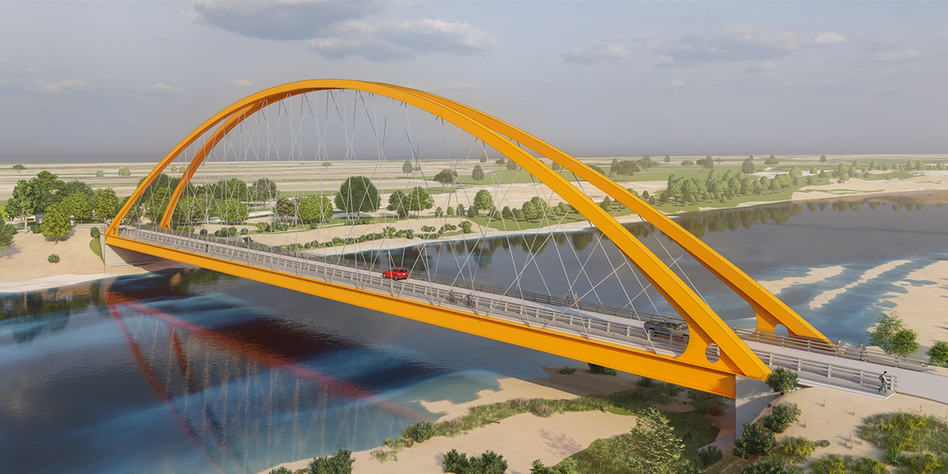
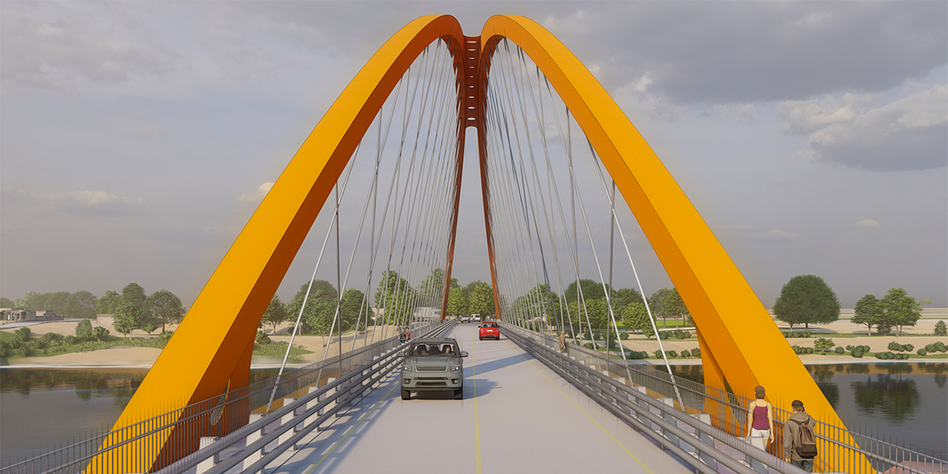
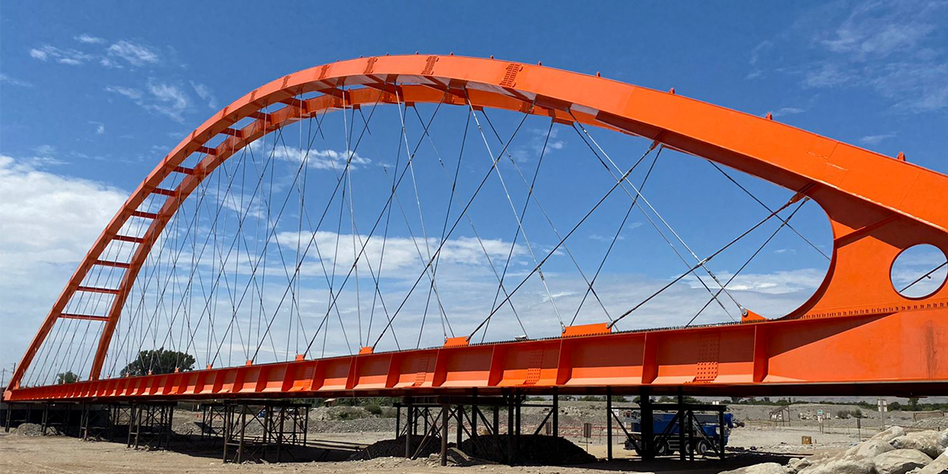
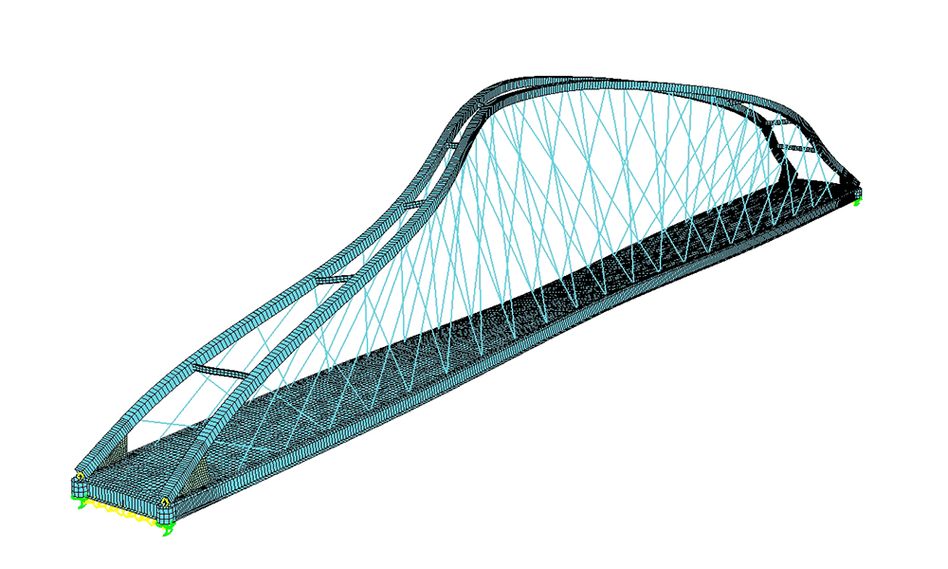
This paper presents the design, calculation and construction of a bowstring arch with network hangers configuration of 160 m span, double plane of transversely braced metal arch inclined inwards and mixed deck formed by two longitudinal beams joined by transverse beams and concrete top slab.

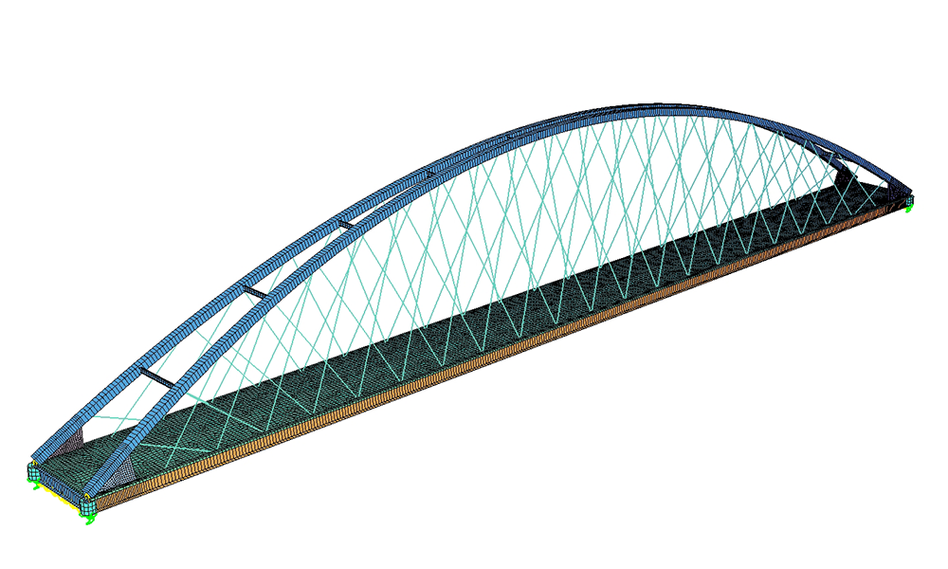
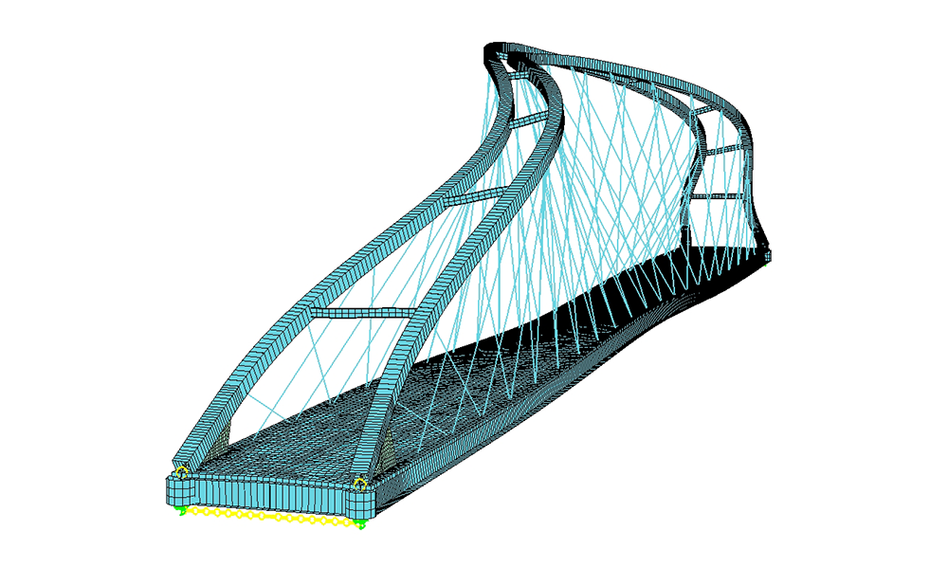
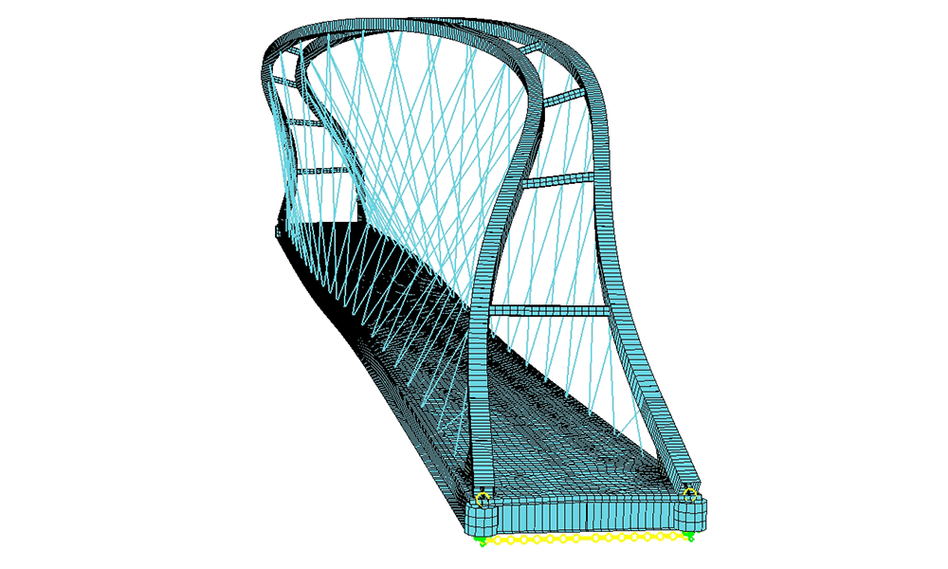
The calculation model developed with SOFiSTiK was used to develop the complete design of the structure. The study of the global behavior was carried out using a 3D spatial finite element model combining linear beam elements (used for the arch and the longitudinal and transverse girders of the deck) with shell or plate elements to reproduce the behavior of the slab and the arch-deck connection zone.

The hangers were modeled as cable elements defined as pinned at their ends and without the capacity to resist compression (tension-only). Seismic isolators were included via linear springs with dynamic properties defined by the stiffness of the isolators according to the evaluated design hypothesis, whether in Service Limit State, Strength Limit State, or Extreme Event Limit State for seismic loading.

The design code used was AASHTO LRFD. Therefore, all verifications for both the superstructure and the substructure were performed, as is standard, according to the limit state approach. The structure exhibits composite steel-concrete behavior under service loads. In contrast, self-weight loads are resisted solely by the steel structure during the construction phase of the upper slab. The model combining shell and beam elements allowed for an accurate evaluation of stress concentrations in the slab at the arch-deck connection, enabling the appropriate distribution of reinforcement steel.

The load in the hangers was established to balance both the self-weight and the dead loads. For this purpose, two loading stages were planned so that the permanent loads are actively carried. The verifications performed in SOFiSTiK also included the verification of the arch stability against non-linear effects (second-order analysis). In general, the in-plane buckling of the arch is effectively controlled by the crossed configuration of the hangers. This specific feature allows for a reduction in the flexural strength requirements of the arch section.

In the transverse direction, buckling is primarily controlled by means of the transverse beams arranged as bracing between the arches. The second-order analysis performed is based on the verification of the arch under service loads (traffic, wind, self-weight, etc.) by including an initial imperfection and a non-linear calculation to evaluate instability. An incremental analysis is performed in which the loads on the arch are progressively increased. Structural failure occurs when any of the sections reaches its ultimate strain. The calculation includes geometric nonlinearity and material nonlinearity through their respective constitutive curves.