Choose language


Choose region

Ashdod Harbor Bridges 3.1 & 3.2
Ashdod, Israel

Client

Ramet Ltd.

Owner

Israel Ports Company (IPC)

Engineering

Noam Avidan

Structural engineering

AVIDAN Engineers Ltd.

Incremental launching bridges – parametric precision meets structural performance 

Designing bridges using the incremental launching method (ILM) demands an exceptional balance of geometric control, structural accuracy, and construction-stage simulation. In  its latest project, AVIDAN Engineers implemented a fully integrated digital workflow combining parametric design, advanced structural analysis, and BIM detailing:

Parametric modelling in Rhino + Grasshopper

A fully dynamic parametric model was developed in Grasshopper, allowing instant control over bridge geometry, including:

  • variable span lengths and pier positions,
  • longitudinal slope and curvature,
  • cross-section transitions and
  • launching stage geometry (step-by-step updates).

This approach enabled rapid design iterations and seamless integration of geometry into both structural and BIM environments.

FEA and prestressing analysis with SOFiSTiK

Using SOFiSTiK, AVIDAN Engineers conducted detailed finite element analysis, simulating each launching stage and calculating:

  • time-dependent effects (creep, shrinkage),
  • prestressing sequences using TEDDY,
  • support reactions as well as internal forces during launching and
  • final-stage stress envelopes.

Prestressing tendons were optimized through scripting and linked directly to Grasshopper, creating an intelligent link between geometry and structural behaviour.


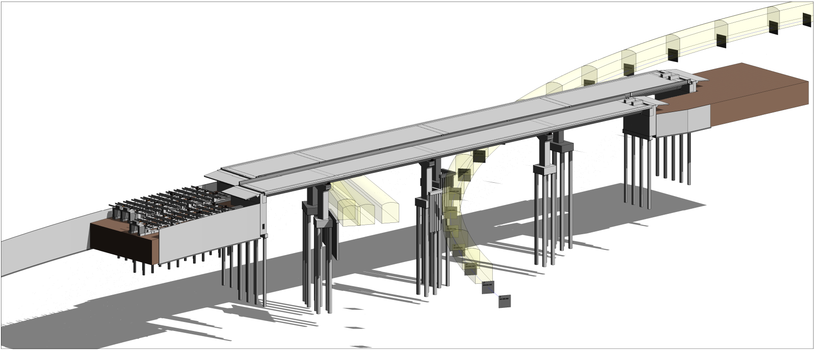
Full 3D BIM model in Autodesk® Revit®

The final bridge model, including reinforcement and prestressing tendons, was built in Autodesk® Revit®.

  • All geometry and rebar were generated based on the parametric definitions.
  • Tendons modelled accurately by stage and stress group.
  • Reinforcement detailing fully aligned with Eurocode and project standards.
  • Quantities and drawings extracted directly from the 3D model.

This integrated workflow significantly enhanced design accuracy, shortened timelines, and enabled deep insight into construction behaviour – from concept to construction stage.